
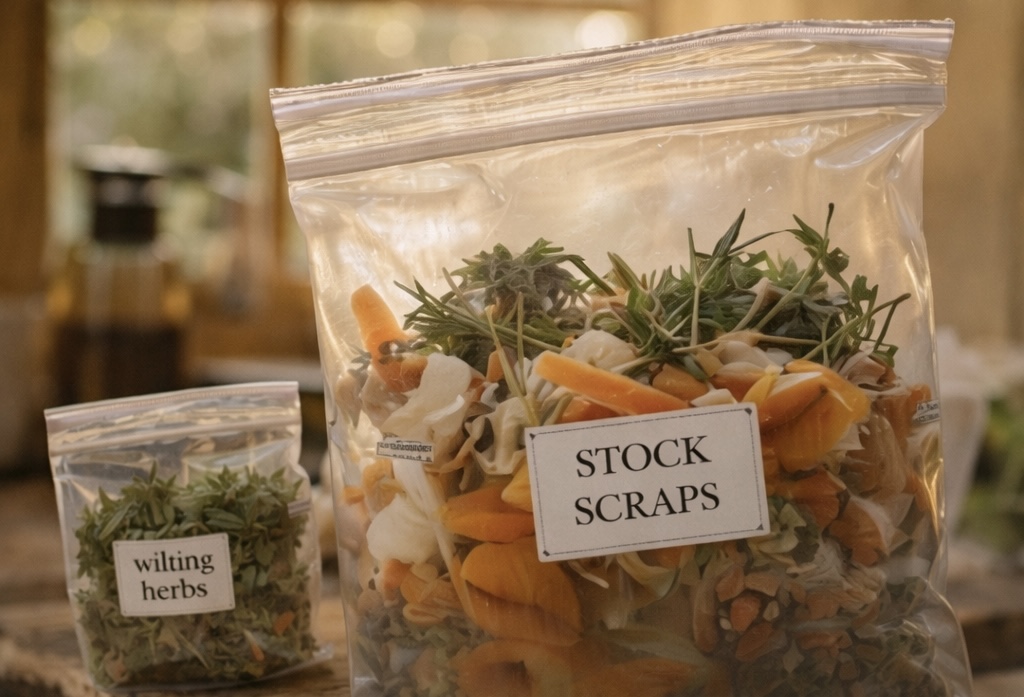
Stock-making is my favorite quiet ritual that anchors my kitchen. It begins not with a shopping list, but with repurposing what I already have — saving onion and garlic skins, carrot ends, celery roots, and the bones left behind after a meal.
This recipe is a way of honoring what remains. By transforming vegetable scraps and leftover chicken or beef bones into a deeply nourishing stock, we extend the life of our food and return value to what might otherwise be discarded.
The process is slow and simple, filling the home with warmth while extracting nutrients, minerals, and flavor from the simplest things.

This stock is so versatile. It is the foundation of hearty soups, stews and sauces. It adds protein and essential nutrients to every recipe. It can replace water in any recipe, even when boiling grains. It can turn flavorless rice into a delicious, nutrient dense, complete protein. It is wonderfully flavorful on its own to kickstart healthy digestion first thing in the morning or as a soothing late night protein source.
Each cup contains 5-10 grams of protein, but it’s nearly impossible to have just one!

By saving scraps and bones and simmering them slowly, you can create a rich, flavorful stock that supports both nourishment and waste reduction. This method works for chicken, turkey, beef, or vegetable-only stock and can be adapted to whatever is available in your kitchen.
A Few Tips for a the Perfect Stock Every Time
1. Think in Balance, Not Measurement
Aim for a loose balance of vegetables to bones, but don’t worry about exact ratios. If you have more scraps than bones, or vice versa, the stock will still be flavorful and nourishing.
2. Start with Cold Water
Cover your scraps and bones with cold water and bring the pot up to a gentle simmer slowly. This helps extract minerals and flavor more effectively.
3. Keep It Gentle
A low, steady simmer is key. Boiling aggressively can make the stock cloudy and reduce the water too quickly. Patience yields depth.
4. Avoid Strong or Bitter Scraps
Onion skins, carrots, celery, garlic, and herbs work beautifully. Avoid cruciferous vegetables (like broccoli or cabbage) and starchy peels, which can turn the stock bitter. For a complete list of which scraps to save for stock, visit Jennifer’s Kitchen.
Remember to add herbs at the end (in the last 30 minutes of simmering) for the same reason.
5. Season at the End (or Not at All)
It’s best to leave stock unsalted until it is finished simmering or season later when using it in recipes. This keeps it flexible and prevents over-salting.
6. Trust Your Senses
If it smells rich and comforting, you’re doing it right. Stock is guided more by intuition than instruction.

A Simple Guide to Making Stock
Step 1: Gather What You Have
Collect vegetable scraps you’ve been saving along with leftover chicken, turkey or beef bones. There is no need for everything to be fresh or perfect — frozen works just as well. What matters is that it has been cared for and saved.
Step 2: Fill the Pot
Place everything into a large pot and cover generously with cold water. Leave a little space at the top so the pot doesn’t feel crowded. This is not about exact ratios — simply enough water to let everything move freely while nutrients are extracted.
Step 3: Simmer
Bring the pot to a boil, then reduce to a slow simmer over low heat. The stock should barely bubble. Let it simmer quietly — this is where patience turns into nourishment.
Step 4: Let Time Do the Work
Simmer for:
- 2–4 hours for vegetable stock
- 6 hours for chicken or turkey stock
- 6–8 hours for beef stock (note that these times are not for raw bones)
There is no need to hover. Check occasionally, add water if needed, and let the kitchen fill with warmth.
Step 5: Strain
When the stock smells rich and comforting, strain out the solids. What remains is the essence of what you saved — deeply nourishing and patiently earned.
Step 6: Save
Allow the stock to cool, then store it in the refrigerator for up to 5 days, or freeze in jars or silicone trays for future meals. This is nourishment saved for another time.
Gentle Reminder
This stock is intentionally non-specific. There are no exact measurements and nothing to perfect — because it is nearly impossible to get wrong. If it smells good and feels grounding, it has done its job.
Cook Time
6 hours
Yields
10+ cups
Ingredients
- a large pot
- 1 large freezer bag full of vegetable scraps
- bones from 1-2 chickens, 1 turkey or 1kg of beef bones
- 1 bay leaf
- a small bag of frozen herb stems (optional)
Steps
1
Add the bones, vegetable scraps and bay leaf to a large pot and fill to the top with water.
2
Bring to a boil on high then reduce to low and simmer for 6 hours.
3
In the last 30 minutes, add the herb stems (optional).
4
Remove from heat and use immediately or wait for the broth to cool before storing. Add salt before enjoying.
This stock recipe uses what is left behind to create something sustaining. It is economical, grounding, and deeply satisfying.

This stock is incredible in my Healing Turkey or Chicken Soup Recipe.